Showing posts with label barcelona markets. Show all posts

October 07, 2019

Palo Alto Market Barcelona Fest

Palo Alto Market Fest Meat and Chimichurri Sandwich by Dos Boludos

The Palo Alto Market Fest is all you can expect from a festival, it is indeed a fiesta in which locals and foreigners alike have indulged year after year, on the first weekend of every month to be more precise. Based on the idea of Javier and Pedrin Mariscal and their foundation, the Palo Alto Market Fest is part of a bigger project, a creative hub, an island within the city, that implied the rescue of the old and abandoned Gal i Puigsech factory not without discrepancies with the town hall.


The Palo Alto festival, encompasses a little bit of everything you can expect from a street market plus an extra and much more relevant additive: culture. In the particular cozy atmosphere of its inner space in which art galleries blend with food trucks, you can enjoy concerts, workshops, exhibitions, find vintage articles, handmade crafts, recycled products, the latest trends in design, beautiful jewelry, street style fashion, organic food, you name it.

Palo Alto Market Fest inner courtyard

This privileged 3,700 m2 space is a great opportunity for local artists and creators to display their work and the ideal place for visitors to get in contact with what's cooking in street or urban culture in Barcelona while pampering one's stomach.

Admission to Palo Alto Market Barcelona 2019: 4.50 eur on site, 3.50 online.

February 12, 2018

Best Local Markets to Cover When in Barcelona

Art and craft, vegetables and meat, trinkets and souvenirs, the markets of Barcelona boast of having the most delicious produce, the most intricate art, dynamic people and energetic atmosphere. Plan your vacation in such a way that you can include all of the wonderful things that the city markets have to offer.


Markets of Barcelona


For a true foodie, Barcelona is nothing less than a shrine. Meat, seafood, vegetables and fruits all collected fresh in the morning is a lovely sight to behold. Team it up with local chefs working their magic, the aroma of the fresh spices, and you have the best gastronomic experience one can ever have! For all those looking to take back memories in the form of trinkets, you will find here a number of antique shops giving you precious delicates that will forever be special to you. And for an art lover, adding to the beauty of this ancient city are the modern artists spreading the joy of colours.


Take a look at our list of the best local markets to cover when in Barcelona and plan your trip soon!


Mercat de Sant Josep de la Boqueria


Often called as La Boqueria, this market is the most famous market of Barcelona. A tourist magnet, you will see people flooding the streets of the market to get the best foodie experience of the city. Famous for the fresh produce that it offers, it prides in selling fruits, vegetables, meat, flowers, spices and everything that would tickle your senses.


Mercat de la Concepció


Photo credits: Gerhidt


Famed to be the best “social” market in the city, Mercat de la Concepció aims to bring people together. With excellent food options, this market organises events and activities for people to get to know the city and one another better. A delight to be a part of, this is shopping, dining and mingling at its best!


Mercat de Santa Caterina


The most significant part of this market is its roof. Not as large as the others, but definitely not less diverse, you will be attracted to its atmosphere like a bee is to a flower! Mercat de Santa Caterina flaunts a vibrant design, a work of art by Enric Miralles, Benedetta Tagliabue and the artist Toni Comella. Mosaic art flashing hues of fresh produce, you will not be disappointed by the offerings of this market.


Mercat del Ninot


Photo credits: Jordiferrer

An authentic experience of Barcelona food, this is the market where the locals shop! Fresh produce of vegetables, fruits and meat fill the trays early in the morning, and the fresh aroma is tantalising. A hidden gem in the city, a casual morning shopping tour will only do you good.


Mercadillo de la Plaça de Sant Josep


Mercadillo de la Plaça de Sant Josep is an artist’s haven. Opened as a tradition every week, this market features 15 artists who come to showcase their talents. The hues, the strokes and the emotions that flow through the air are surreal and mesmerising. Also boasting of a fun side to it, artists are more than happy to discuss art, and caricatures can be enjoyed at every other stall!


Mercat de Sant Antoni


Photo credits: Valugi


One place that has it all, Mercat de Sant Antoni showcases to its visitors, clothes, souvenirs, and trinkets, as well as fresh fruits, meat and vegetables. One of the largest markets in the city, it is frequented by locals. To get an exotic shopping experience, don’t forget to include it in your itinerary!

April 18, 2017

Mercat of Sant Antoni: Restored Market to Open in 2018


After 8 years of work, the remodeled Mercat de Sant Antoni is expected to be open to the public during the first months of 2018. With an important investment made by its own market stand owners and the local government, around 60 million EUR all in all, another jewel in the history of Barcelona, will be recovered in all its splendor. Do not expect it to be just like La Boqueria or at least that is the intention of the project that seems very concerned with the avalanche of tourists in Las Ramblas.

The addition of more space, including two new squares plus the inclusion of a small museum (an archeological excavation site has unveiled part of the old city walls and Via Augusta) promise to make this 135 old market something more important than just a collection of stands. There will be 4 underground floors, two for parking lots, 1 for storage and 1 for commercial areas.


The origin of the Mercat de Sant Antoni is a remnant of the 13th century Mercat dels Encants, a marginal market outside the walls that was moved to Carrer del Consolat in 1850. In 1882, Rovira i Trias finished building the iron market, and there were almost no houses in its surroundings, the working class neighborhood of El Raval.

Update 02/02/2018: According to several sources the restored Mercat de Sant Antoni will be opened by the end of April or beginnings of May. Local retailers have accepted the proposal of using awnings for the Sunday market and the book market. Such awnings will be located in the areas which were previously the market yards, now regained for public use. Lighter retractable metal canopies in a highly resistant metal structure will be used.

March 03, 2014

Carnival 2014 in Barcelona: The Actors


Last Saturday was La Rua's day of Carnival 2014 in Barcelona. La Rua is the Catalan name for the  parade that takes place in some carnivals around the world and as usual in these events people let their imagination fly. As you should know from previous posts here in Barcelona Photoblog about Barcelona's Carnival, there is the main parade and then there are secondary ruas in many districts of the city. Besides the floats and the parades it is very common to see shop clerks or market staff working in their costumes as you can appreciate in this picture taken at one of the stands in La Merce market. This week I am going to show some costumes both from the market and the streets and I would like to thank those who gently accepted to pose for the camera. Please check also: Some days of Pagan Joy, Carnival Costumes, Feather Masks

April 12, 2011

Fish stall at Mercat de la Mercé, Nou Barris, Barcelona

Fish stand at La Merce market, Barcelona, Spain

Who said a female fishmonger had to be rude, shabby and smelly. Well, I guess they smell of fish of course but certainly these girls have a wonderful look. I realize my comments are stupid but I wanted to muse on cliches around professions. I don't know in your country but at least here I remember one: You shout like a fishmongeress, something that of course is not always true. Maybe you can share other cliches you've heard of in your city.

July 07, 2010

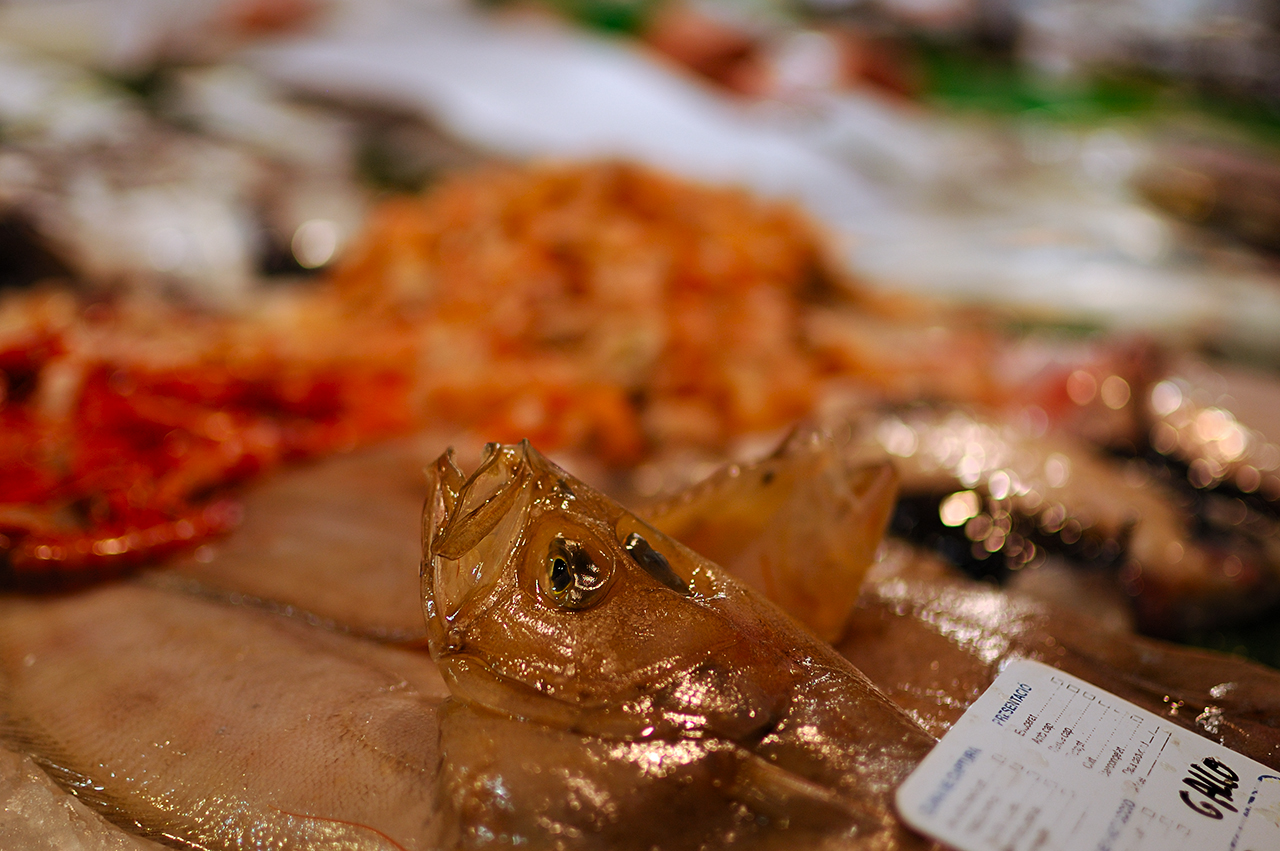
Megrim (Gallo) at Market Stall in Barcelona

Megrim (Gallo) at Market Stall in Barcelona

This is what I think is a Megrim sole or Whiff (Lepidorhombus whiffiagonis) a species of flatfish. In Spanish we call it Gallo, the French call it Cardine and Italians, Rombo Giallo. It is also referred to as white sole or lantern flounder. I mentioned a totally different fish called Gallo before in Barcelona Photoblog. Well, what's in a name. The point is I am always attracted by the looks of market food, of dead animals displayed kind of artistically to lure customers. I hope this still life portrait serves taxonomists and food enthusiasts alike. Before I say goodbye today let me tell you that megrim is inexpensive and quite good for soup. Although it is not very tasty, it can be served filleted along with other ingredients. Try this recipe: Cornish Megrim poached in a white wine and mushroom sauce.

May 18, 2010

Fish Monger Stand: Sea Breams at Abaceria Central Market, Barcelona, Spain

Fish Monger Stand: Sea Breams at Abaceria Central Market, Barcelona, Spain

After a rather brief existence this is how it all came to an end. Yep, this is me, an innocent sea bream lifelessly lying somewhere in a Gracia market fish monger stand. It didn't have to be this way, I could have avoided those fishermen and so I wouldn't be here looking at you with such cold fishy eyes. They want to eat me and they don't even know my name. Well, they have this stupid habit of giving names to stuff, so they wonder if I am a gilt-head sea bream, a common dentex or a black sea bream. My friends used to call me porgy although I always preferred, fish, just fish.

April 13, 2010

Boqueria Fish: Fresh Gallo

Boqueria Fish: Fresh Gallo

As with all species mentioned here in the past, there is a certain percent of error in the classification I give since many times I forget to write down names when I take pictures. This one looks like a John Dory or Zeus Faber (Gallo, Ceo, Zeo or Pez de San Pedro in Spanish).

The name Gallo (rooster) is also given to other species of fish in Spanish that are different in appearance and have different scientific names such as Lepidorhombus wiffiagonis aka Megrim.

This is not an ichthyology treaty so just concentrate on the fresh appearance and the fact that you can buy some at La Boqueria market in Barcelona or maybe other fish posted in Barcelona Photoblog recently.

Update 2023: Due to the huge popularity of the original post (for reasons still unknown to me) the frustrated scientist in me (who dreamed of being a marine biologist) has decided to abound in the topic and do some justice to the beauty of a John Dory or Gallo fish.

The Zeus Faber: A Remarkable Species with Many Common Names

The Zeus Faber: A Remarkable Species with Many Common Names

The Zeus Faber, also known as the John Dory, is a unique and iconic fish species found in the coastal waters of the eastern Atlantic Ocean and the Mediterranean and Black Seas. As a fan of marine biology and ichthyology, the study of fish, I am fascinated by this distinctive fish and its many common names across languages.

In English, the Zeus Faber goes by several colorful names, including John Dory, St. Peter's fish, and dory. The name John Dory is thought to be a corruption of the French jaune doré, meaning golden yellow, referring to the striking yellow and black patterning on the fish's body. St. Peter's fish comes from the myth that the dark spot on the fish's flank is the thumbprint of St. Peter, left there when he removed a coin from the mouth of a fish.

In Spanish, this fish is known by two main names: gallo and pez de San Pedro. Gallo means rooster in Spanish, an apt description of the Zeus Faber with its tall dorsal fin resembling a rooster's comb. Pez de San Pedro mirrors the English St. Peter's fish, referencing the biblical apostle.

In Catalan, Zeus Faber is called Gall de Sant Pere or Gall or Sant Pere. Gall means rooster, like the Spanish gallo. Sant Pere means St. Peter.

It is fascinating how the common names in English, Spanish, and Catalan all draw comparisons to a rooster's comb or reference St. Peter. These creative names speak to the Zeus Faber's distinctive appearance and religious legends surrounding the species. However, it is important to note that gallo in Spanish refers to a different fish species in some regions.

Taxonomy and Classification

From a taxonomic perspective, the Zeus Faber belongs to the family Zeidae under the scientific order Pleuronectiformes. As a flatfish, it is closely related to other dorsally-asymmetrical fish like sole, flounder, plaice, and halibut. Its genus name Zeus derives from the Greek god, while its species name Faber comes from the Latin word for craftsman.

The Zeidae family contains just one other species - Zeus gurnardus, or the gurnard John Dory. The John Dory is larger in size and has a deeper body than the gurnard John Dory. Both species are found in the Mediterranean and eastern Atlantic.

Key Characteristics

The Zeus Faber exhibits several unique external characteristics that distinguish it from other fish:

  • Tall, extended first dorsal fin resembling a rooster's comb
  • Distinctive black and yellow color pattern on body
  • Large, spiny head
  • Small mouth with teeth
  • Asymmetrical, flat body shape
  • Dark spot on flank thought to be St. Peter's thumbprint

The John Dory can grow up to 60 cm in length and weigh up to 2.3 kg. It has a compressed, oval-shaped body and is broader than it is deep. The eyes are located on the right side of the head, with the left side of the body appearing white or blind. Small, fine teeth line the jaws.

The flank patterning features a golden yellow background with six distinct black vertical bands. Black or blue markings surround the pectoral and caudal fins. The John Dory's scaleless skin is very thin and semi-transparent.

Habitat and Distribution

The Zeus Faber inhabits the coastal waters over sandy, muddy, and rocky seafloors along the eastern Atlantic coast from Norway to South Africa. It is abundant throughout the Mediterranean and found as far east as the Black Sea.

John Dory live mainly at depths between 10 - 250 meters, but occasionally venture to 350 meters deep or come to the surface. They prefer saltwater temperatures between 10 - 20°C. Though mostly solitary, these fish occasionally form small schools around rocky coastal areas or reefs.

Predators and Prey

With its large mouth and sharp teeth, the John Dory is an opportunistic carnivore that feeds on a variety of smaller fish, cephalopods like squid and octopus, and crustaceans. Some key prey items include anchovies, sardines, mackerel, shrimp, and crabs.

Despite being predators themselves, John Dory fall prey to larger carnivorous fish like groupers, larger tuna, barracuda, and sharks. Their camouflage coloration helps them avoid detection from above. John Dory have also been observed following venomous weever fish, likely for protection from predators.

Gallo in Spanish

As mentioned earlier, the name gallo in Spanish also refers to a different species - the whiff, or Lepidorhombus whiffiagonis. The whiff belongs to the same order as the John Dory, Pleuronectiformes, and shares its asymmetrical flat shape. It is found in the northeastern Atlantic and Mediterranean.

Like John Dory, whiff possess camouflaged coloration, although they lack the distinctive patterning. Instead, whiff display sandy brown, yellowish, or reddish hues to blend in with seabeds. They have a slightly oblong, oval profile.

While whiff and John Dory overlap in range, their depth and temperature preferences differ. Whiff stay closer to shore in shallower, warmer waters of 80 - 150 meters depth. The similar body shape and habitat likely accounts for the shared common name of gallo, despite being different species.

Culinary Significance

The Zeus Faber holds an important place in European cuisine and food culture. In England, the John Dory has long been revered as one of the finest eating fish. Due to its notoriously low population numbers, however, it remains an expensive and prized delicacy reserved for gourmet seafood lovers.

Valued for its fine white flesh and subtle flavor, John Dory are often baked, pan-fried, or grilled. Chefs carefully fillet the spiny fish to remove bones and skin. The meat stands up well to a range of sauces and spice rubs.

In Catalonia, John Dory appears in classic seafood stews and rice dishes.

Overfishing Threats

Regrettably, John Dory populations have declined over the last several decades due to overfishing. They are extremely vulnerable to trawl and gillnet fishing methods. Their habitats have also been degraded by destructive bottom trawling practices.

John Dory reproduce slowly, taking 2-3 years to reach sexual maturity. Their low fertility and slow growth mean they are very slow to recover from population declines. For these reasons, sustainability organizations like Seafood Watch recommend avoiding Atlantic-caught John Dory.

However, fisheries in the Mediterranean have made progress with more responsible management. Mediterranean-caught John Dory are a better choice for sustainability. With conscientious consumer demand and smart regulations, we can prevent the loss of this iconic species.

The Zeus Faber remains one of the most unique and cherished fish in the ocean. While many know it as John Dory, St. Peter's fish, or gallo, marine biologists recognize its scientific name that pays homage to both mythology and taxonomy. Safeguarding this species for future generations will require a collective effort between scientists, fisheries managers, chefs, and consumers who appreciate its value. With some care, this fabulous fish can continue thriving for centuries to come.

February 17, 2010

Carnival in Barcelona: La Merce Market

Carnival in Barcelona: La Merce Market

Another picture from this particular series taken in La Merce market last weekend during Barcelona carnival celebrations. I guess it is not very comfortable to work wearing a joker costume but it all helped cheering up the season and the lousy weather.

February 15, 2010

Barcelona Carnival: Butcher in Disguise at La Merce Market

Butcher lady holding carving knife and wearing carnival costume

La Merce market in Nou Barris quarter (Pg Fabra i Puig 270-272) participated as usual in the Barcelona carnival activities. As it is traditional at this time of the year workers wore costumes while serving clients. In the picture this lady butcher with wig and red hat had no problem in skillfully slicing that chunk of meat. Maybe you came out with some artificial hair in your food but who cares, it is carnival time.

October 28, 2009

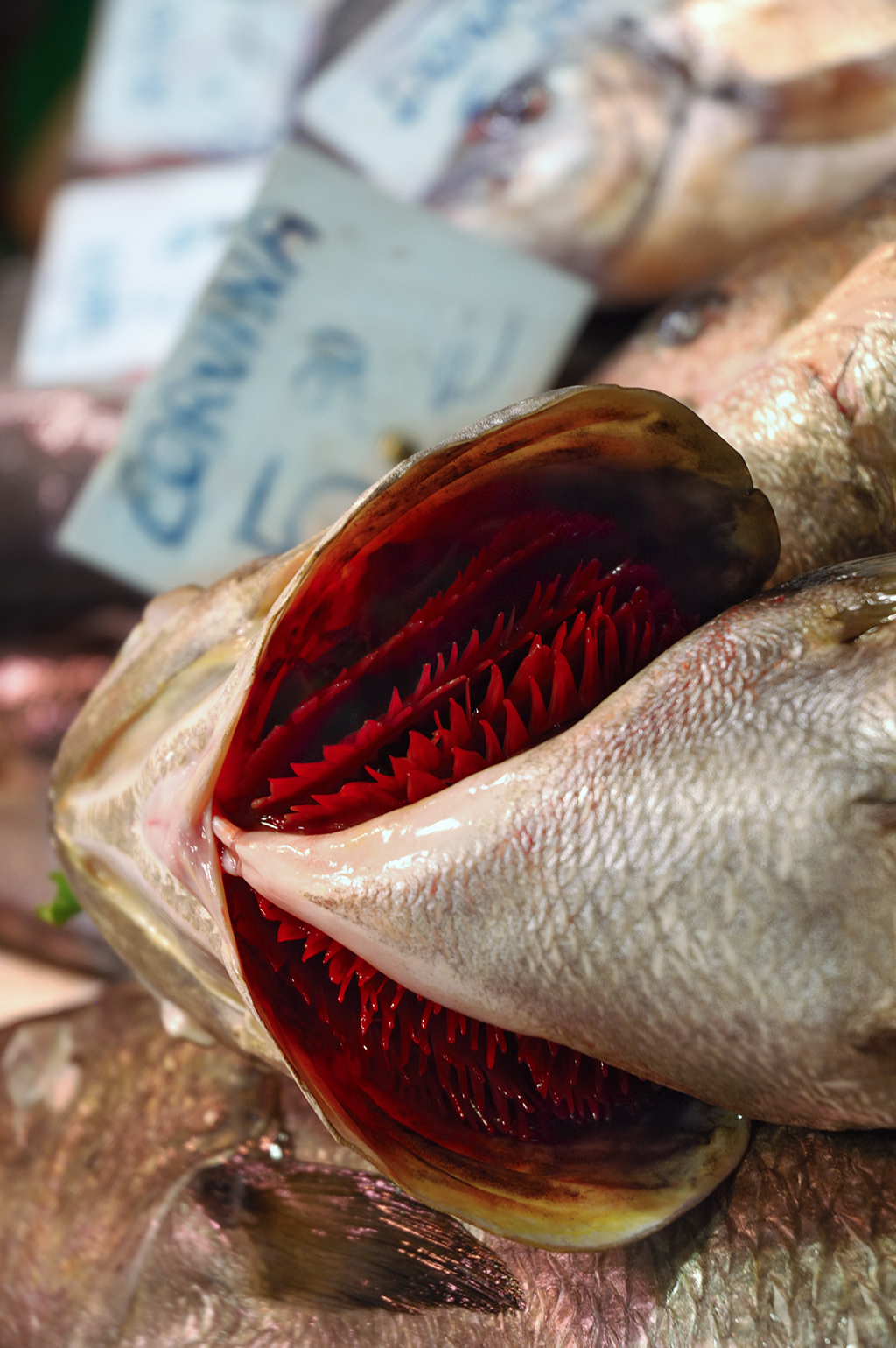
Gills - Corvina Fish, La Boqueria, Barcelona

Gills - Corvina Fish, La Boqueria, Barcelona

Today, another dead fish and for a change in La Boqueria market. Yep, posts are somehow fishy lately. Well, fishmongers must be glad, ichthyologists not much, and Barcelona fans, eager to watch other hot spots in the city, rather disappointed. I found the gills of this fabulous corvina extremely attractive so I thought, what the heck, one more for the blog before I say, so long and thanks for all the fish!

October 22, 2009

Straws - La Boqueria Market

Juice with colorful straws at Sant Josep Market or La Boqueria Marquet in Barcelona

Whoever has visited La Boqueria market has probably seen the attractive display of colorful straws on the chilled glasses of orange juice.

I have to confess I rarely try one of those. You know, locals sometimes avoid the obvious specially when we think something is too much tourist-oriented. But one thing is certain, the presentation is fantastic and not just because some straws match FC Barcelona soccer team colors but also because of the perfect arrangement, the ice, the froth and the smell of fresh fruit.

In fact, I think I am being pretty unfair and stubborn in this case. Whatever you do, please don't miss this stall at the very entrance of La Boqueria market. Take a break and enjoy a refreshing glass of juice à ma santé!

October 18, 2009

Seafood Stand, Boqueria Market, Barcelona

Seafood Stand, Boqueria Market, Barcelona

Yesterday, I went to La Boqueria market and took some more pictures. For those who were interested in images that were more on the report side and less on the artistic one here is a general view of a seafood stand. There are others with more fish but I thought you would like to see the shells and some people buying stuff. Once more, there's a contradiction here: my first impulse would be to show only those beautiful gigantic shells from a close distance but you want to see more of the market. I understand. Maybe a little bit of everything is better. When you capture all the scene then you start getting some noise, like a bottle, a box, people talking on the right, a man turning his back on us, etc. But then again this blog is meant to please you more than myself. If not it would be a monologue.

June 28, 2009

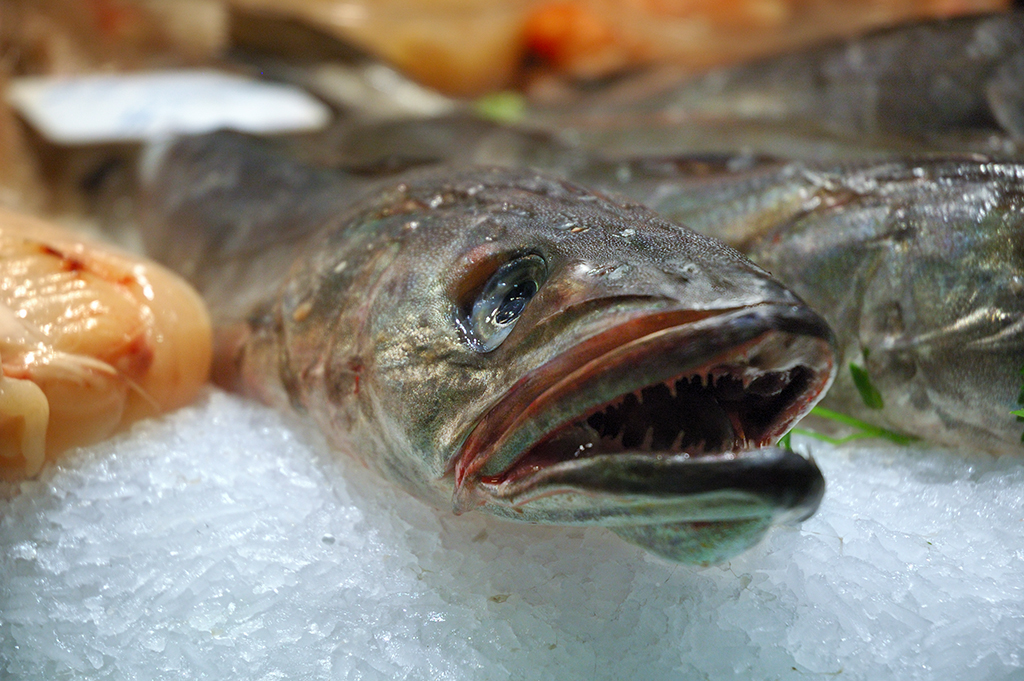
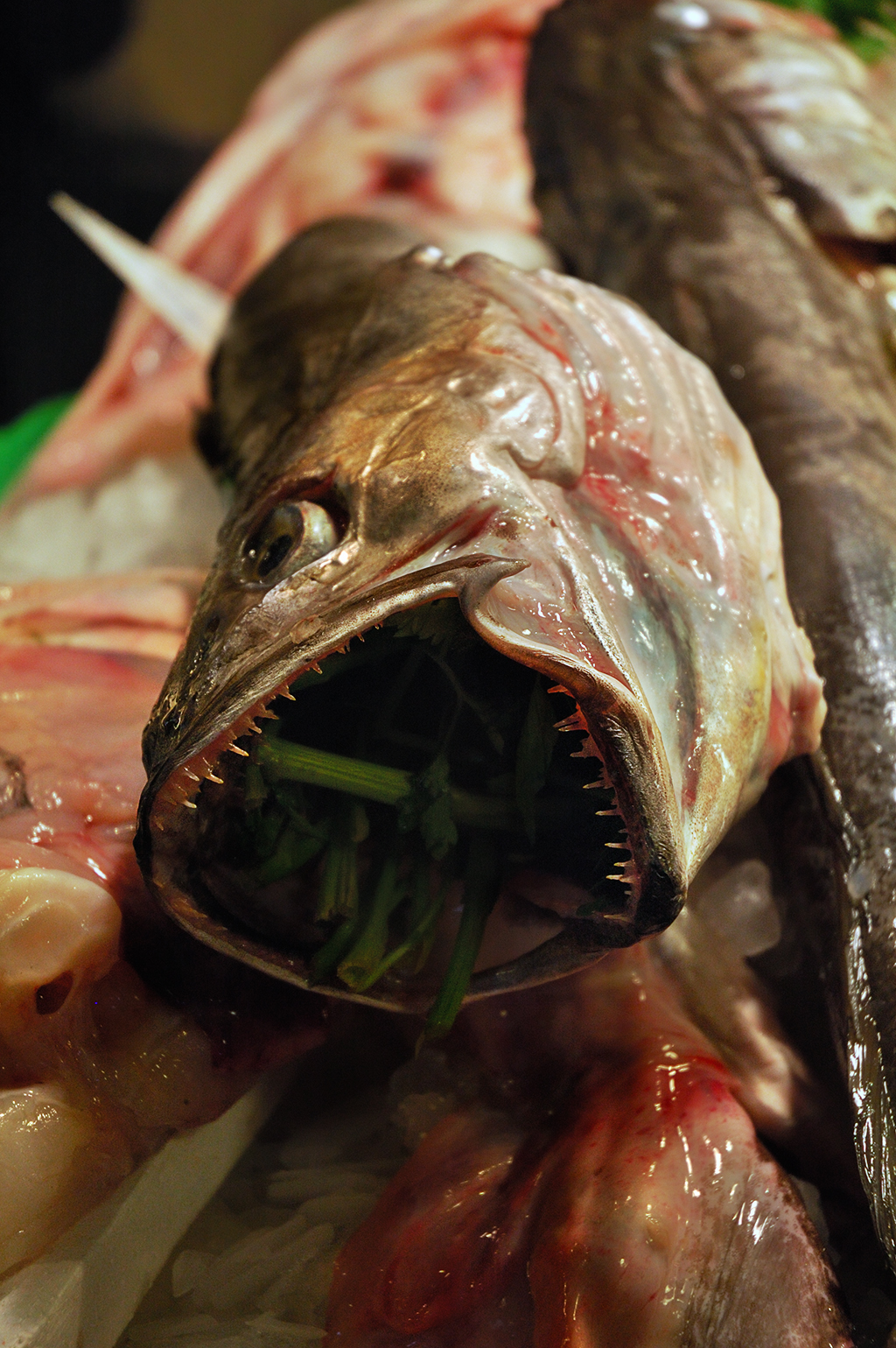
Hake Detail, La Boqueria Market, Barcelona

Hake detail at La Boqueria Market fish monger stand

As part of my La Boqueria market series I wanted to show you this detail of a hake which is one of the most consumed fish species on the Spanish table. Here are some essential recipes to enjoy hake: Merluza a la Gallega (Galician-style hake), Merluza a la Vasca or Koxkera with clams and white wine (Basque-style hake) and Merluza a la Bilbaína (Hake Bilbao-style), there are many more of course. Remember to accompany them with a good white wine, like Albariño for example although I would prefer a good Godello wine from Valdeorras DO like an elegant Godeval

June 02, 2009

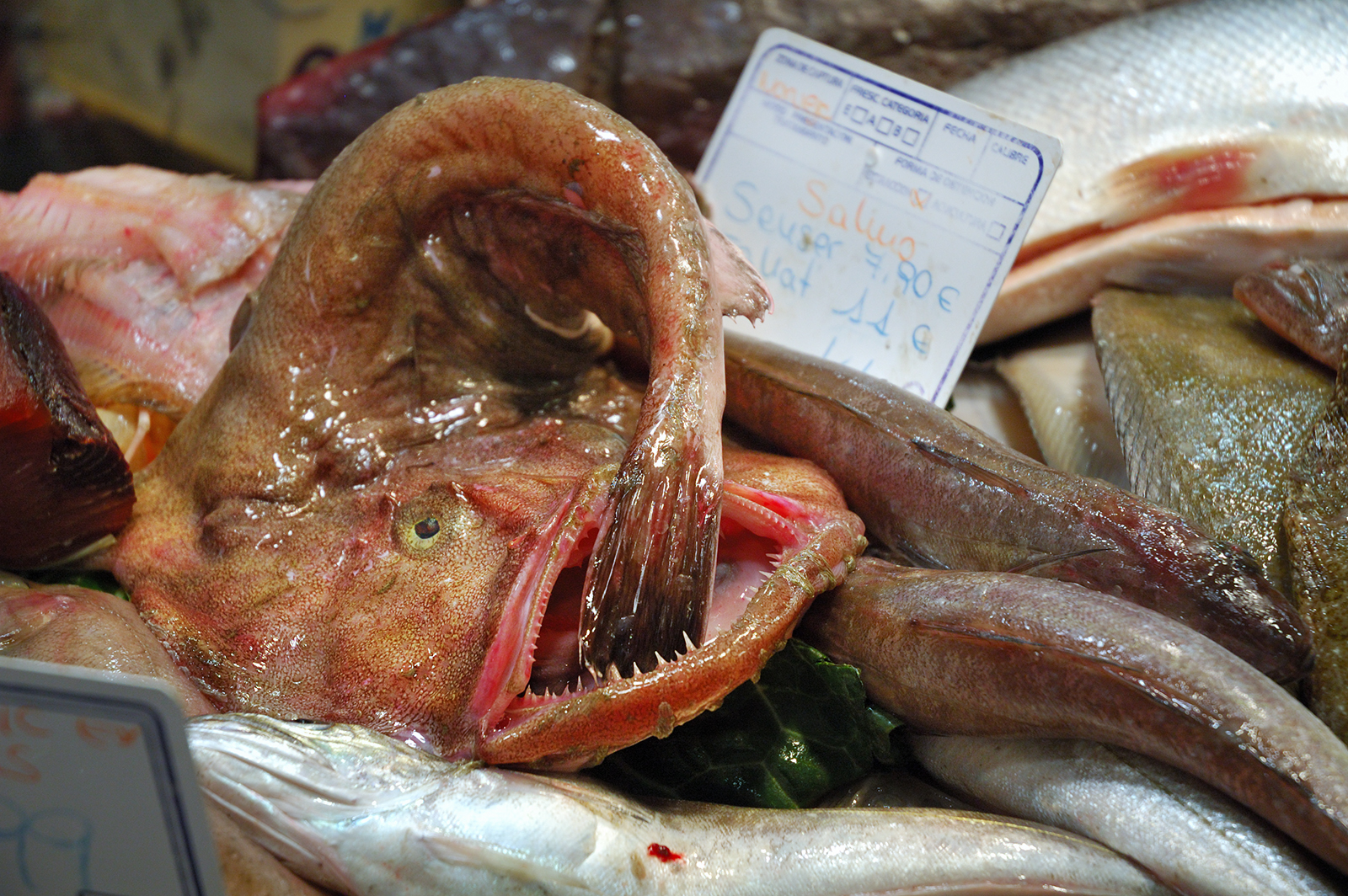
Monkfish: A Delicious Monster

Monkfish

One of the ugliest fish there ever was, monkfish, is however highly appreciated because of its delicious taste and tender meat. When I see them in the market, I can't help wondering who was the first human to try such horrible creature. I reckon that ugliness is a relative term, and that the idea we have of a monster is intimately related to our psyche, our dreams. I think it is a matter of symmetry. If you take a look at this fish at La Boqueria market, the first thing that calls our attention is that big mouth, totally out of proportion. Besides, the body is flat and the eyes are on top. It doesn't look at all like a "normal" fish. As you see, we apply our concept of beauty, of harmony, to animals too. Monkfish remind me of abyssal fish in spite of living in the continental shelf (200 m approx.) and the continental slope (up to 1000 m). They even have that dorsal spine above which they use to lure preys which resemble fishing rods (that's why they are anglerfish too) so familiar when we think of deep water fish. The abyss by itself generates fear in our minds. Every time they bring out some fish from the bottom it has that demon-like aspect, pretty common in old illustrations about the sea and journeys towards remote, unknown corners of the world. I wonder why so? It is not the monkfish's fault to have benthonic habits, that is, to live in the bottom and have adaptations to that habitat, like the flatness, the position of the eyes, the color of the skin and the enormous mouth. What turns that into a monster? When did it appear as such in our primitive mind?. That fear of the unknown together with a menacing look might trigger a signal indicating danger to our existence. Who knows! Maybe we'd better kill the monster and eat him just in case. Some monkfish recipes to have at hand after the "killing".

April 13, 2009

Fish Market, La Boqueria, Barcelona

Fish Market, La Boqueria, Barcelona

The fish section of La Boqueria market is not only a good place to buy fresh fish but also an attractive spot to take your camera and let go your imagination. I think this image is rather cruel or looks like some still life painting perhaps but that's the way it is with food. We kill to survive. I hope someone bought the rest of this fish. At least, they didn't have to use its head as promotional bait in vain. La Boqueria is one of the most important markets in Barcelona and sells a great variety of products. It is said that what you don't find there you won't find elsewhere. I can't guarantee that but its stalls are a pleasure to the eye and a must-see during your stay in the city. Here is an old post with another image and a video: Visit La Boqueria Market in Barcelona.

November 30, 2008

Ladybird with Mistletoe, Christmas Present at Santa Llucia Market

Ladybird with Mistletoe, Christmas Present at Santa Llucia Market [enlarge]

This would be my humble postcard to wish a Merry Christmas to all my faithful visitors. I wish you all have a very nice month of December and a happy new year. I hope these ladybirds with mistletoe found at famous Santa Llucia market bring you all the luck this coming 2009.

September 07, 2008

Visit La Boqueria Market in Barcelona!

Lamps in La Boqueria Market, Barcelona, Spain

Most important cities in the world have markets which they are more or less proud of, not because we as inhabitants are going to earn profit from selling products but due to the fact that major markets are a representation of traditions and cultural legacy handed down from past generations.

What I mean is that we as a community are proud of El Mercat de la Boqueria or Mercat de Sant Antoni or Mercat del Ninot, because part of our history is present in those premises, in the architecture, in the products sold, in the way they are displayed, in the way things are cooked or the advice they give us to prepare a nice dinner the way our grandparents did, in the daily thriving of so many families that have been in this trade for ages.

This is what we are and how we are and is good to see that visitors like it and get to know Barcelona in one of the most ancestral ways of doing it, by the food. Check this video of La Boqueria Market by denniscallan.


Remember you can spot La Boqueria market on my Flickr map!

September 04, 2008

Curly Endives or Chicory Detail at Boqueria Market, Barcelona, Spain

Curly Endive or Chicory Detail at Boqueria Market, Barcelona, Spain

Resuming my previous post a couple of days ago about La Boqueria market at Las Ramblas, I wanted to share some green with you. Salads are not my favorite. I am more of a carnivore, meat lover, red fan. Nevertheless I reckon the other half of the world goes crazy about chewing up leaves, gnawing on stems and grazing in one way or another which is totally respectable. Here is a detail of a curly endive or chicory that we call escarola. This might lead to confusion cause escarole in English is a plant with broader leaves. Escarola is a rather common green salad in Catalonia, some people love it. I don't. It tastes bitter and is beyond my crunching noise limit. Anyway, the serrated leaves are beautiful and carry lots of healthy minerals, or so they say. I have accentuated the colors using lab color effect. I digress. I hope vegans and vegetarians don't take me too seriously today. I recommend this site (Notes from Debbie's Kitchen) with lots of veggie recipes classified by key ingredients and clearly illustrated with pictures. And I forgot to say that La Boqueria market is just the right place to quench your green thirst.

April 30, 2007

Green Veggies at Ninot Market in Barcelona

Green Veggies at a Market in Barcelona


Just a curious way to dress up the stall at Ninot market in Barcelona. I am not fond of veggies and low carb vegetarian diets but have to admit they make a market stall quite more attractive.
Web Analytics