June 11, 2008

Street Market: Colorful Ribbons or Bracelets With Girl Names

Street Market: Colorful Ribbons or Bracelets With Girl Names [enlarge]

Something I like about street markets in Barcelona and the rest of the country is that many times when you don't like what you see you can always go and refresh your eyes with the explosion of colors of South American stands. I mean, there is always a Bolivian or Peruvian stall where you don't know exactly what's on sale but you can't help staring with curiosity. Something is telling you that you want to buy. Not because of the pottery, the Che Guevara or Bob Marley T-shirts and the familiar leaf silhouette, not because of these personalized ribbons or bracelets with girl names but because of the whole impression, the warm colors, the Latin flashy hues that make the stand look more appealing than the rest. For me, much better than a 50 percent off sign.

June 10, 2008

Rusty Door Knocker in Torrelles de Llobregat , Barcelona, Spain

Rusty Door Knocker in Torrelles de Llobregat , Barcelona, Spain [enlarge]

This beautiful rusty door knocker I captured at Torrelles de Llobregat near Barcelona although it could have been in Barcelona city perfectly as here we have many. The knocker represents some kind of mythological being perhaps. What do you make of it? I think I kind of like old door knockers and maybe I collect them in the future, the images of course. I remember a couple of posts in Barcelona Photoblog that you should check too: Vandalized Door Knocker or Modern Art? and Knocker on Chocolate Color Door at El Raval Quarter, Barcelona. Or maybe you prefer a list of famous door knockers.

June 09, 2008

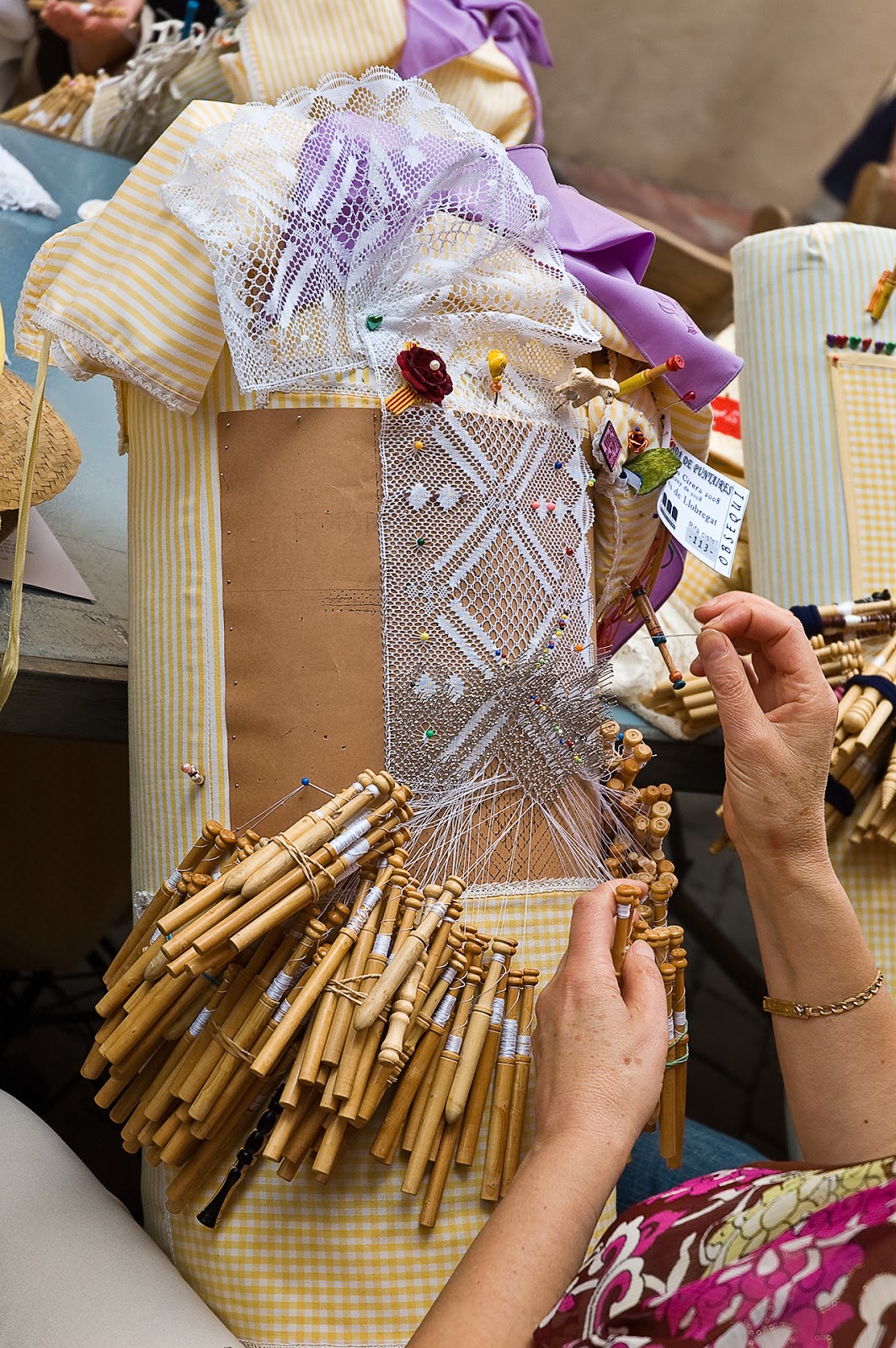
Bobbin Lace or Encaje de Bolillos, Torrelles de Llobregat, Barcelona, Spain

Bobbin Lace, Pillow Lace or Encaje de Bolillos, Torrelles de Llobregat, Barcelona, Spain

This is a picture I took in Torrelles de Llobregat. You can see here in detail how bobbin lace, known in Spanish as encaje de bolillos, is made.

First you need a pattern or parchment where holes are pricked to mark the place for all the pins. The parchment is always laid on a pillow or cushion. The lace is worked with each hand holding at least a pair of bobbins, the wooden elongated spools or shuttles hanging from the threads, which are moved from side to side to form a twist, a braid, or a clothlike fabric called toile. The motifs are worked in a more dense stitch, and the ground is made with a looser stitch.

Bobbin lace originated in Flanders in the early 16th century although some say it came from Italy. From Flanders it extended to the rest of Europe. It was used for ruffs and collars back then.

In Spain it was customary to teach girls how to work bobbin lace at school and at home as it was considered an essential part of a woman's education.

Check this video about bobbin lace. It is short and not too illustrative but it has a brief explanation in English that might help.
Web Analytics