Showing posts with label gaudi. Show all posts

December 18, 2025

The Patron, the Palace, and the Myth: 5 Surprising Truths About Gaudí and Palau Güell

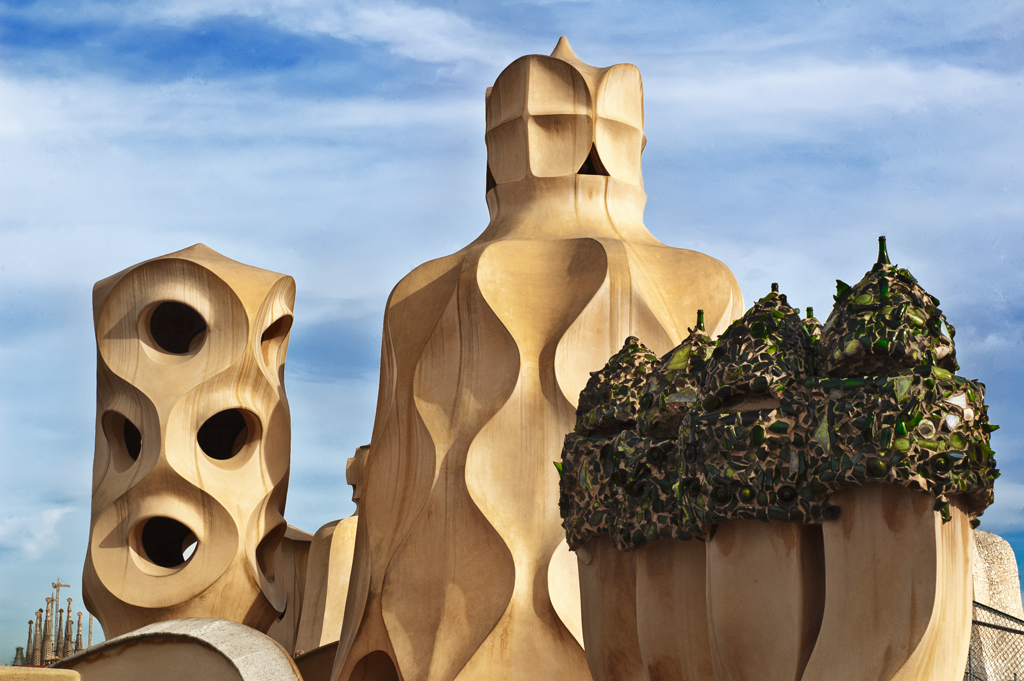
Chimney or vent with trencadis mosaic detail at Palau Güell by Gaudi in Barcelona

More Than Just a Fantastical Facade

When we think of Antoni Gaudí, our minds often conjure images of whimsical, almost surreal structures that seem to have sprung from a dream. The melting-wax towers of the Sagrada Família, the dragon-scaled roof of Casa Batlló, the gingerbread gatehouses of Park Güell—these are the icons of a fantastical Barcelona. His work feels playful, radical, and perhaps even a little eccentric.

But behind the undulating facades and kaleidoscopic mosaics lies a story far deeper and more complex than this popular image suggests. At the heart of this story is one of Gaudí's most important early works, the Palau Güell. More than just a striking building, this palace is a testament to the legendary partnership between a revolutionary architect and his visionary patron.

This article peels back the layers of myth to uncover five surprising truths about Gaudí, Eusebi Güell, and the urban palace they created together—revelations that will change the way you see their enduring legacy on the city of Barcelona.

1. Gaudí's Patron Was Far More Than Just a Wealthy Client

It's easy to dismiss Eusebi Güell as simply a man with the money to fund Gaudí's grand visions. The reality is that he was a pivotal figure in Catalan industry and culture, deeply woven into the fabric of the city's power structure. Güell was not just a patron of the arts; he was a force of the establishment.

His political connections were significant and generational. A staunch monarchist, Güell's establishment ties were fortified by marriage and family tradition. His father-in-law was the powerful Marquès de Comillas, and together their families had cultivated intimate relations with the Crown since the time of Isabel II and Alfonso XII. This deep-rooted loyalty was so profound that King Alfonso XIII eventually granted him the title "Count of Güell" in 1908. Furthermore, the Güell family was a key promoter of the city's most ambitious civic projects, including the Universal Exhibitions of 1888 and 1929, events that put Barcelona on the world stage.

This context is crucial. It reveals that the partnership behind some of Barcelona's most avant-garde architecture was a powerful convergence of radical art and establishment influence. Güell wasn't just hiring an architect; he was channeling his considerable industrial and political power into a creative vision that would shape the city's future.

2. Palau Güell Wasn't a Public Spectacle, It Was a Family Home

Despite its palatial scale and prominent location on Carrer Nou de la Rambla, just steps from the city's busiest thoroughfare, the Palau Güell was not commissioned as a museum, a concert hall, or a public monument. It was designed and built for a remarkably intimate purpose: to be the private family residence for Eusebi Güell and his family.

This fact fundamentally reframes our understanding of the building. The grandeur of the facade, the opulent interiors, and the innovative use of space were all conceived to serve the needs of a family's daily life, albeit an extraordinarily ambitious one. It represents a unique blend of public-facing ambition and private domesticity, a statement of the Güell family's status and place within the city.

This is a counter-intuitive point because it forces us to see the building not as a mere architectural showpiece, but as a deeply personal space. It reveals the unique vision Güell had, not just for Barcelona's skyline, but for his own family's legacy within it.

3. The Common Image of Gaudí is a Complete Misconception

In modern culture, Gaudí is often painted as an eccentric genius whose work was an untamed explosion of fantasy. This popular interpretation, however, dramatically trivializes his true motivations and the profound ideology that underpinned every creative decision he made. As the writer Robert Hughes noted:

We had heard about Gaudí but we got him entirely wrong, because we knew little or nothing about his deeply Catalan roots, his obsession with craft culture, and his deeply right-wing piety. We thought he was some kind of proto-surrealist weirdo, which trivializes his achievement.

Gaudí's genius was not random; it was grounded in three unshakable principles. First was his profound connection to his Catalan identity, which infused his work with regional symbolism and history. Second was a deep reverence for traditional craftsmanship, rejecting industrial mass production in favor of the artisan's hand. And third was a fervent, deeply right-wing piety that shaped his worldview and ultimate masterpiece, the Sagrada Família.

Understanding this transforms Gaudí from a whimsical fantasist into a deeply serious and ideologically driven artist. His architectural revolution was not an act of surrealist fancy but a deliberate, disciplined expression of his cultural, spiritual, and political beliefs.

4. Their Partnership Was a Lifelong Creative Epic

The collaboration between Antoni Gaudí and Eusebi Güell was not a one-off project; it was a lifelong creative partnership that spanned decades and produced some of Barcelona's most iconic landmarks. This sustained relationship, built on immense mutual trust and a shared vision, went far beyond the palace on Carrer Nou de la Rambla.

Their major collaborations chart a course across the landscape of Catalan Modernisme:

  • The Pavilions for the Finca Güell: Their very first project together, a magnificent gatehouse and stables for Güell's summer estate.
  • The Palau Güell: The grand family residence in the heart of the city.
  • The Cellers Güell: A complex of wineries designed in the Garraf region.
  • The Church for the Colònia Güell: A structurally radical, though unfinished, church for Güell's industrial colony.
  • Park Güell: Their most famous joint venture, a visionary garden city that, while never fully realized as planned, remains one of the world's most beloved public parks.

This decades-long patronage is incredibly rare. Güell provided Gaudí with the creative freedom and financial backing to pursue some of the most ambitious and experimental architectural projects of the era, cementing a legacy that was truly a shared creation.

5. This Palace Was a Bold Early Statement, Not a Late-Career Flourish

To truly grasp the significance of Palau Güell, it's essential to place it correctly within Gaudí's career. The palace was constructed between 1886 and 1888. This puts it at the very beginning of his journey as an architect, immediately following his first major commission, Casa Vicens (1883-1885).

It predates by many years the works that would make him world-famous: Park Güell (1900-1914), Casa Batlló (1904-1906), and Casa Milà, "La Pedrera" (1906-1910). When Güell entrusted him with designing his family home, Gaudí was not yet the global icon we know today. He was a young, rising talent with a radical vision.

This timing underscores the immense faith Eusebi Güell placed in him. In commissioning Palau Güell, the powerful industrialist was taking a significant risk on a young architect, empowering him to make a bold, defining statement. The result was a masterpiece that not only launched Gaudí's career into the stratosphere but also set the stage for the architectural wonders that would follow.

A Deeper Look at Barcelona's Icons

The story of Palau Güell is far richer and more meaningful than its fantastical facade might suggest. We see not just a building, but a monument to a unique partnership between a staunchly monarchist patron and a deeply pious, avant-garde architect. It is a family home that became a public icon, and an early masterpiece that foretold a legendary career.

By looking past the myths, we uncover the true nature of Gaudí's deeply held beliefs, Güell's immense influence, and the profound trust that allowed them to reshape Barcelona. Their legacy is not just built of stone and tile, but of a shared vision that continues to enchant the world.

Now that you know the story behind the stones, how does it change the way you see Gaudí's Barcelona?

```

September 03, 2016

Sagrada Familia: Ceiling Detail


Here are a couple of images put together portraying details of the ceiling inside Sagrada Familia Cathedral in Barcelona. There are many of these ornaments that remind me of royal seals or who knows, cava corks. Anyway,I just wanted to show you yet another beautiful spot of this magnificent masterpiece of art. I hope to recover my normal posting soon. I never find the right moment to find the strength to get into blogging again.

December 11, 2015

Crypt Pillars and Ceiling at Sagrada Familia Cathedral


Close your eyes and think about architecture, try to establish a pattern of what is something astonishingly beautiful for you and for people in general and I am sure that when you open them again you will hardly come even closer to what Antoni Gaudi should have had in his mind when he created these beautiful pillars and that odd ceiling for his Sagrada Familia Cathedral. Who would have thought of such daring strange shapes then, by the end of the XIX century and who can think of them right now unless you take a computer and use an advanced software to calculate mathematical possibilities for architectural impossibles.

October 05, 2014

Canopy and Crucifix, High Altar, Sagrada Familia

Canopy and Christ on the cross, Sagrada Familia

Above the High Altar at Sagrada Familia's temple, there is an Expressionist “Crucifixion of Christ”, a bronze version of a work by sculptor Carles Mani i Roig (1866-1911). The sculpture hangs from a beautiful canopy over a block of porphiry from Iran acting as a very austere table.

November 22, 2011

Gaudi Chimneys: The Amazing Surreal Shapes of Catalan Art Nouveau

Amazing Chimneys on the roof of Casa Mila or La Pedrera building by Antoni Gaudi
Chimneys by Gaudi - Casa Mila aka La Pedrera's Roof

When you step into Casa Mila's rooftop, you enter a surreal realm of uncanny figures begotten in the womb of some eerie creature or conceived in the unfathomable labyrinth of a very insane but wise mind, figures that remind alien chrysalids about to eclose or deceiving chess pieces that seem to move ominously behind your back.

Apparently they are only chimneys but definitely there is something mysterious about them, as if they had been alive and were now under some spell. Some may resemble totems, others look vigilant towards the horizon like soldiers watching from the battlements of some medieval castle. Many interpretations are possible here. Whatever your appreciation is in the end, you certainly will not remain indifferent.

March 11, 2011

La Pedrera or Casa Mila: Inner Court and Air Shaft

La Pedrera or Casa Mila: Inner Court and Air Shaft

Casa Mila also known as La Pedrera, by Antoni Gaudi, as seen from above is a magnificent sample of fully functional organic Art Nouveau design. Notice the undulated eaves, the arched attic walls that used to hold the washrooms, the small windows not always at the same level to allow ambient light and provide ventilation for the laundry and the peculiar inner court and air shaft of the building. Perhaps you would get the mood better if you admired La Pedrera in this video on YouTube about modernista architecture in Barcelona.

March 09, 2011

Casa Mila by Gaudi: Modernist Staircase Detail

Modernist Staircase at Casa Mila, Barcelona

Art has many ways, just as mother nature never stops surprising us with her capricious designs. The creativity of man knows no boundaries and a good example of that is the work of Catalan genius, Antoni Gaudi. In this image, the staircase at Casa Mila also known as La Pedrera is just a staircase, a beautiful one in fact, but the handrail, oh, the wrought iron handrail is so profuse in impossible adornments, so elaborate, that it is difficult not to surrender to this architect's divine talent. Not that complex motifs were invented by him, since we have Baroque for that, but the new approach, the use of natural elements like leaves, conceived with such uncanny mathematical precision, sometimes quite hard to translate from his mind into the final piece, makes these architectural jewels unique.

January 20, 2011

Casa Batlló: Masked Balconies

Mask Balconies at Casa Batllo by Gaudi, Barcelona

To stay in Barcelona without visiting Casa Batlló is like being in Paris and forgetting about the Eiffel tower, with all due respect to Sagrada Familia and Sacre Coeur respectively.

The famous house designed by Gaudi is so, let's say, 'different' that tiptoeing her is almost a sacrilege.

Besides the exquisite trencadis (shattered tiles) on the façade, the balconies are like carnival masks, concealed faces watching upon passersby.

The whole building has more to do with patterns we usually find in nature than with man's rationale, like the peculiar contours of the roof that simulate some sort of scaly skin as that of a lizard or a snake, or why not, a dragon, or the impossible arches and oval windows in the lower floors deprived of everything that recalls a straight line.

I tried to apply some symmetry at the moment of framing the picture but it was certainly pretty hard.

Here is a previous post about Casa Batllo.

January 02, 2011

Gaudi's Army of Chimneys on La Pedrera, Barcelona

Modernist Chimneys by Antoni Gaudi on La Pedrera or Casa Mila Roof

Hi everyone,

This is Barcelona Photoblog's first post in 2011. I hope this year brings the best for all of you. Without your presence here this blog would mean nothing and I really appreciate you take the time to read me. What is more representative of Barcelona than Gaudi's works? To say the truth, few things. That's why, I want to salute the second decade of this XXI century with more chimneys from La Pedrera aka Casa Mila.

All the best,

Carlos Lorenzo

December 14, 2010

Casa Mila: Face-Like Roof Figure

Casa Mila aka La Pedrera: Face-Like Roof Chimney

Resuming Casa Mila posts, this is another astonishing figure by Gaudi that reminds me of those enigmatic monolithic statues on Easter island (Isla de Pascua) except for the fact that this one is hollow and is one of La Pedrera's roof chimneys. Admiring this beauty will cost you just 11€ (Audio guide takes an extra 4€) with 10% discount in case you arrive on the tourist bus.

December 09, 2010

La Pedrera: The Gaudinian Mastery of Geometry

Roof detail of Casa Mila - La Pedrera by Gaudi

Antoni Gaudi, a genius of architecture and superlative artist dominated geometry like few others.

In modern times he would certainly be working in the video game industry as a designer creating 3D virtual worlds with due respect to the obvious differences of course.

This is the roof of renown Casa Mila, which is, together with Casa Batllo and Sagrada Familia, one of the best samples of Gaudinian creative and geometry aware imagination.

In black and white the lines are more evident as in some sort of charcoal sketch.

July 21, 2008

Dali and Gaudi Souvenirs, Stall at Portal de L'Angel, Barcelona

Dali and Gaudi Souvenirs, Stall at Portal de L'Angel, Barcelona [enlarge]

Another stall at Portal de L'Angel, one of the richest streets in Barcelona. This time selling Dali and Gaudi souvenirs. A couple of days ago I showed you the stand next to this one.


July 02, 2008

Casa Mila: A Whole Lotta Door

Inside view of Modernist Ironwork Door at Casa Mila or La Pedrera by Gaudi

Caught in the spiderweb of art, I fell I had to show you the door from within.

Check the outside here.

A whole lot of ironwork for a door, a huge smashing blow to all former architectural styles, the opening gates to the land of impossible things.

Ladies and gentlemen, welcome to La Pedrera and the imagination of Antoni Gaudi.

June 30, 2008

Ironwork on Balcony at La Pedrera or Casa Mila in Paseo de Gracia, Barcelona, Spain

Ironwork on Balcony at La Pedrera or Casa Mila in Paseo de Gracia, Barcelona, Spain [enlarge]

I am sure this building Casa Mila also known as La Pedrera rings a bell. Maybe you saw the picture somewhere, in a postcard or in some expensive art book. Perhaps you are lucky enough to have visited Barcelona in the past and you wouldn't say no to a second or a third chance to see it. Well, it is never like the real thing, absolutely not, but if you click on today's image of the ironwork on one of the front balconies you will enjoy a very, very close shot of the famous façade. Not that there are few images like mine, but certainly you will appreciate every detail of the floral motifs. For more information read Casa Mila and follow the rest of links in the post.

June 29, 2008

Art Nouveau Lamp at Casa Mila or La Pedrera

Art Nouveau Lamp at Casa Milà or La Pedrera [enlarge]

This impressive art nouveau lamp that reminds me of some ancient diver's helmet or the head of a dragonfly with a little more imagination, hangs from the ceiling in the hall of La Pedrera or Casa Mila, built by Gaudi between 1906 and 1910. Brothers Badia were the iron forgers so I assume they had to do with this lamp but so far I haven't been able to find out who designed such beauty. You can find a thumbnail of La Pedrera on my Google Map below.

April 30, 2008

Holy Water Font or Basin Made With Shell, Colonia Guell's Crypt, Barcelona, Spain

Holy Water Font or Basin Made With Shell, Colonia Guell's Crypt, Barcelona, Spain [enlarge]

Stationary fonts like this are placed at the entrance to churches as you all know but I am sure you never saw a holy water font made with an enormous shell nor have you seen perhaps such wonderful ironwork pedicle. Nothing is common and ordinary when you enter Gaudi's crypt at Colonia Guell. The place has columns, altar, stain glass and pews as any other church but you have to be prepared to digest the degree of variation of the holy elements. A church was supposed to be on top of the crypt, as the latter was part of a bigger project which started in 1908. In 1917 one year after Gaudi's art patron and friend, Eusebi Guell, died, the work was finally stopped. As you can guess foundations are very solid. Columns are made of basaltic rock and different kinds of bricks. The ceiling is vaulted in the most traditional gothic style. Every arch, every pillar, was precisely calculated with small sacks full of pellets which were tied to the ceiling in Gaudi's workshop by means of small pieces of cloth and string making up what is known as a stereostatic model. The weight of every sack was proportional to the load every arch element had to hold. But everything here is hard to imagine without visiting Colonia Güell of course. By the way, there were some posts in Barcelona Photoblog some time ago that might help: Caprice Supreme of Architecture, Modernist Door and Mosaic, Futurist Windows and Stained Glass

March 24, 2008

La Pedrera or Casa Mila, Barcelona, Spain

La Pedrera or Casa Mila Main Façade Silhouette, Barcelona, Spain

As you know this is Casa Milá aka La Pedrera by Antoni Gaudi. 

I can't say much but I recommend you visit previous posts about the art nouveau building at Passeig de Gracia. 

I have tried different angles of the house but this one taken at sunset looked fine enough. Nevertheless I have polarized the façade and added some dramatic sky just out of pure boredom. 

I think it is a building that works when it comes to tweaking reality. Here are some other shots from my archives: Casa Mila, Door Ironwork, La Pedrera in BW and La Pedrera a Barcelona Landmark.

March 13, 2008

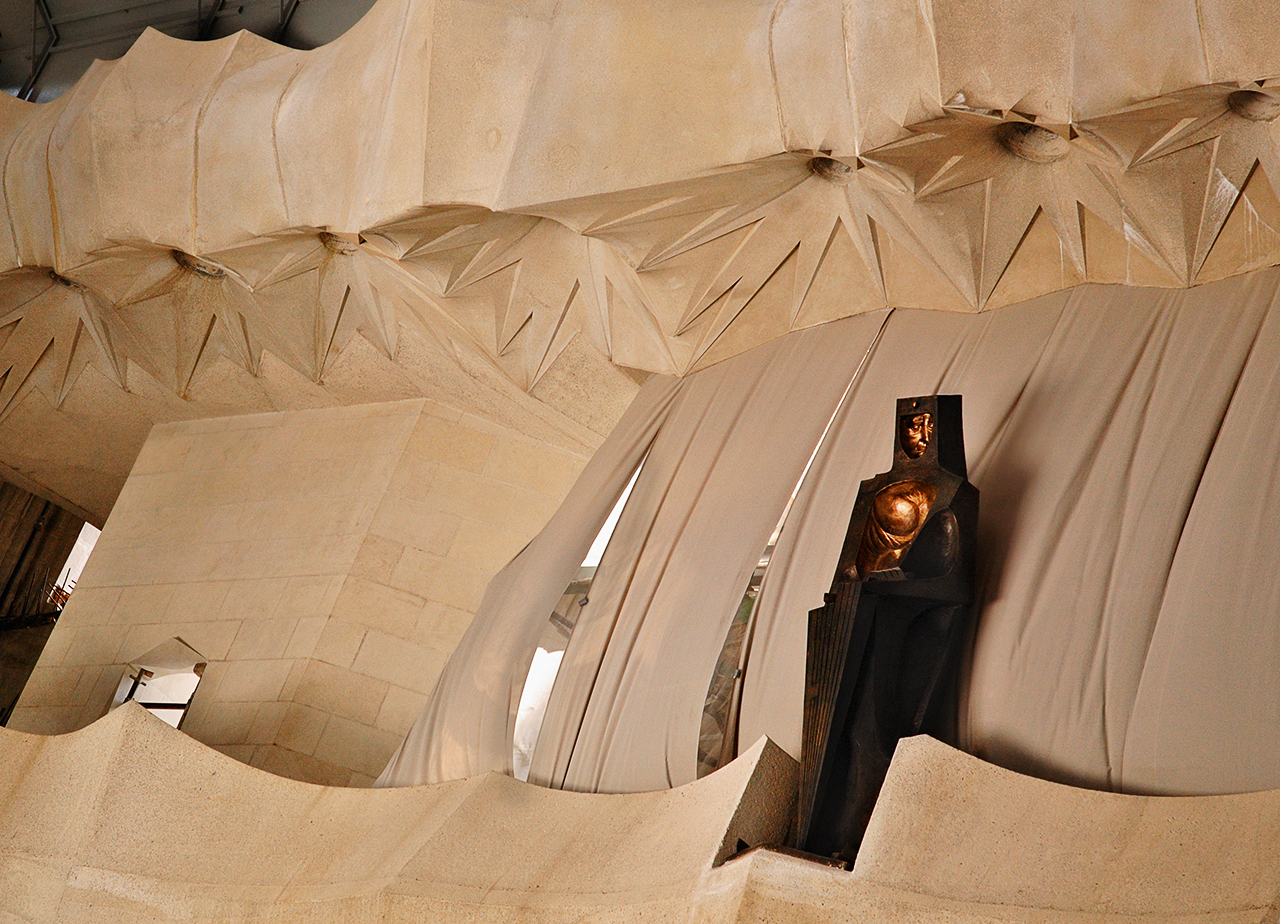
A Gaudian Sculpture Near Sagrada Familia Ceiling

A Gaudian Sculpture Near Sagrada Familia Ceiling

As usual it is hard to crop Gaudi's work. I spotted this weird modernist sculpture near the ceiling at Sagrada Familia. Unlike the ones outside this one is black. I suppose it is some kind of allusion to the Black Virgin called La Moreneta, the patroness of Catalonia but this is just a suggestion of mine.

January 10, 2008

Columns at Park Guell, Barcelona, Spain

 [enlarge]

These are some of the 86 Doric columns under the terrace at Park Guell, Barcelona. The place was featured in Barcelona Photoblog a long time ago so here's a link to: Park Guell Columns

January 09, 2008

Serpentine Bench Detail at Park Guell, Barcelona, Spain

Serpentine bench by Gaudi in Park Guell
Serpentine bench detail at Park Guell by Antoni Gaudi


A detail of a serpentine bench at Park Guell, Barcelona. Not the first time I show you these modernist benches by Gaudi. Using the trencadis technique he composed curious patterns that not only included color tiles but several other pieces that look like bottle bottoms to me. If you enlarge the picture you will be able to see what I mean.

For those of you who have not visited the park I should say that the undulated benches encircle a big terrace with a view over Barcelona and the sea. More posts about serpentine benches in Barcelona Photoblog: Mosaic Work Called Trencadis by Gaudi, Mosaic Serpentine Benches Landmark of Barcelona and Trencadis Serpentine Bench at Park Guell.
Web Analytics