Step into the Gilded Age of Travel at Barcelona's Hotel El Palace
Tucked away on a tree-lined boulevard in the heart of Barcelona lies a
timeless grande dame that transports guests back to the glamorous era of early
20th century travel. Hotel El Palace Barcelona, originally opened in 1919 as
an outpost of César Ritz's famed luxury hotel chain, oozes old world charm and
elegance. From its ornate façade guarded by liveried doormen to the antique
furnishings within, El Palace brings to life a bygone time when travel was
still an exclusive pursuit of royalty and the cultural elite.
The Remarkable Rise of César Ritz
The storied history of El Palace Barcelona begins with legendary hotelier
César Ritz, the pioneering founder of the international Ritz brand. Born in
1850 in the small Swiss village of Niederwald, Ritz was the thirteenth child
in a family of farmers. His mother noticed young César’s intellect and
insisted he receive an education, sending him to a Jesuit boarding school.
There he learned German, French, and English—skills that would prove
invaluable.
At 15, Ritz became an apprentice waiter at a hotel in Brig, Switzerland. But
he was dismissed after a few months, deemed to lack faculties for hospitality.
After a period of uncertainty, ambitious Ritz left for Paris in 1867 to seek
his fortune. The bustling city was hosting the Universal Exposition, creating
many hospitality jobs. Though starting as a waiter apprentice again, Ritz
quickly moved up, honing his skills at top restaurants like Voisin.
Ritz exhibited exceptional talent for remembering guests’ names and
preferences. His amiable personality also attracted important contacts like
the Prince of Wales. But Ritz’s budding career was interrupted by the 1870
Franco-Prussian War. When Voisin closed due to scarce supplies, Ritz returned
to Switzerland. In 1873 he went to Vienna for another Universal Exposition and
met European royalty while working at a fine restaurant there.
For the next decade, Ritz spent winters serving elite clientele on the French
Riviera and summers in the Swiss Alps. In 1889, the Savoy Hotel in London
recruited Ritz and chef Auguste Escoffier to manage their new luxury property.
During his decade at the Savoy, Ritz pioneered innovations like in-room
bathrooms and introduced standards of service and cuisine never before seen in
hotels.
But Ritz dreamed of launching his own luxury hotel. In 1898, he opened the
esteemed Hôtel Ritz Paris. Its elegantly appointed rooms and refined dining
attracted royalty, business magnates, and creatives. The terms “ritzy” and
“puttin’ on the Ritz” stem from this gilded era.
After conquering Paris, London and Madrid, Ritz, who at the beginning was
reluctant to build in Barcelona, was advised by Francesc Cambó, a local
politician and intellectual, on the need of building yet another magnificent
first-class hotel, this time in Barcelona considering pending events like the
1929 Barcelona International Exposition. No expense was spared to create Ritz's
vision of a palatial urban oasis. When Hotel Ritz Barcelona opened in 1919, it
immediately became the city's premier luxury destination.
Although Ritz managed to expand his holdings
globally he finally had to pass his empire to his heirs and retire to Switzerland
due to declining health. When he died in 1918, César Ritz was remembered as
the founder of modern luxury hospitality.
A Storied Past Through War and Peace
In its early years, El Palace cemented its status as the place to see and be
seen in Barcelona. Well-heeled travelers arriving on luxurious cruise ships
docked nearby eagerly made their way to the hotel's elegant spaces. Over the
decades, famous guests have ranged from Spanish royalty like King Alfonso XIII
to luminaries like Ernest Hemingway and Salvador Dalí.
The sprawling Ritz also became a cultural hub for Barcelona's high society. In
the 1920s, its ballrooms hosted splendid masquerade galas, concert
performances and art shows that attracted the city's creatives and socialites.
The hotel's bar served as a lively spot where intellectual figures like
Federico García Lorca and José Ortega y Gasset convened for cultural lectures,
organized by the prominent women Isabel Llorach and Francesc Cambó.
But after the boom of the 1920s, troubling times loomed with the Spanish Civil
War's outbreak in 1936. During the conflict, El Palace became a refuge for
prominent families seeking shelter. Despite the war's chaos, the hotel
maintained an aura of civility and calm. The tireless staff provided any
comfort or service required, even sleeping onsite overnight when commuting was
dangerous.
When war erupted, the hotel transformed into a worker-run cafeteria under the
CNT and UGT unions, providing vital meals for Barcelona's hungry population.
After the war, the grande dame emerged physically unscathed. But isolation
under Franco's regime affected its glittering clientele. However, the hotel
continued operating with world-class service and dignity.
The Grande Dame Regains Her Luster
By the 1950s, Barcelona had begun opening up to the world again. With major
events at the city's expo grounds, El Palace found itself welcoming
international guests once more. A renaissance during the 1960s-70s won the
hotel global acclaim and designation as a Leading Hotel of the World for its
refined amenities.
In 2019, extensive renovations prepared El Palace for its next 100 years by
sensitively restoring original details while incorporating modern comforts and
conveniences. From its elegant facade to the restored interior design, the
hotel brings Barcelona's gilded early 20th century era back to life. The César
Ritz spirit continues through the staff's genuinely warm hospitality.
Famous Guests Over the Decades
El Palace’s premier location and accommodations have attracted many celebrity
guests. Salvador Dalí repeatedly stayed in his favorite luxury suite during
sojourns in Catalonia, once famously bringing up a taxidermy horse as a gift
for his wife Gala, to the astonishment of hotel staff.
Retired bandleader Xavier Cugat, who popularized mambo music in 1940s
Hollywood, spent his later years living at El Palace, filling its ballrooms
with lively tunes in the 1970s and 80s. In 1987, Freddie Mercury met opera
singer Montserrat Caballé at the hotel's bar, catalyzing their creative
collaboration on the song "Barcelona" for the 1992 Olympic Games.
Many other luminaries have repeatedly made El Palace their home away from home
when visiting Barcelona over the decades, including a diverse array of Hollywood
actors, opera singers, rock stars, bullfighters, famous painters, directors,
fashion designers, irreplaceable writers, distinguished members of high society
from nobility to heads of state, from illustrious politicians to Arab sheiks,
from Masons to Nazis, from Republicans to Franco's troops. The list is so
extensive that it makes no sense trying to include them all here.
To celebrate the hotel's 2019 centennial, El Palace unveiled a photo
exhibition with images of its glamorous past events and famous faces. The
hotel's prestigious history and restored elegant spaces continue to transport
guests back to Barcelona's golden era of luxury travel today.
Barcelona's Leading Luxury Destination Through the Years
In many ways, the history of El Palace mirrors that of Barcelona itself. The
hotel was the city's premier luxury destination from the moment its doors
opened in 1919, attracting affluent travelers and hosting high society events.
In the carefree 1920s, its ballrooms and restaurants were the epicenter of
Barcelona's buzzing cultural scene. El Palace was witness to pivotal historic
moments like the 1929 World's Fair and the Spanish Civil War in the 1930s.
During the economically depressed postwar years, the hotel weathered
challenges but continued as an oasis of refinement. By the 1960s, a rebirth of
Barcelona's cosmopolitan spirit coincided with El Palace's renewed golden era.
The city became an international travel hotspot once again, and the hotel its
glittering social hub. The 1992 Summer Olympics spotlighted Barcelona on the
world stage, drawing renewed interest in its Belle Epoque splendor.
Today, extensive restoration work ensures El Palace remains Barcelona's most
illustrious luxury hotel. Its timeless elegance comes alive in the ornate
facade, the crystal chandeliers glittering in palatial event spaces, the
frescoed ceilings and marble floors.
For over a century, Hotel El Palace Barcelona has maintained its stature as
the crown jewel of Catalan hospitality. It continues César Ritz's legacy as
the pinnacle of discreet luxury experiences, attracting discerning travelers
today as it did Barcelona's elite in its 1920s heyday. A fascinating living
link to the city's past remains vibrantly alive within El Palace's historic
walls.
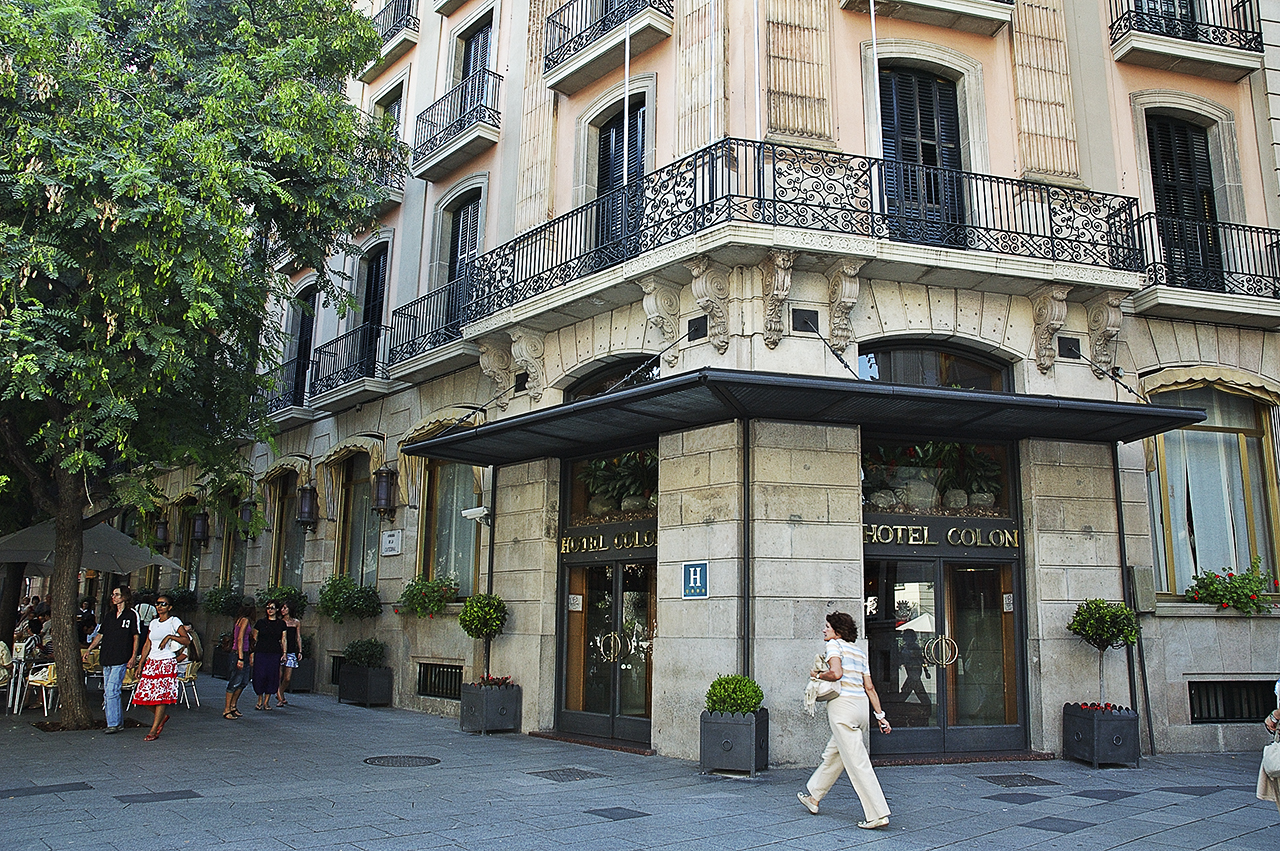


![Comtes de Barcelona Hotel at Passeig de Gracia 73 [enlarge]](https://farm3.static.flickr.com/2083/2314843399_29fdb0c6c3_o.jpg)




![[enlarge]](https://blogger.googleusercontent.com/img/b/R29vZ2xl/AVvXsEhqs-pPPcWo_XXDEwaUjYSi4K-krQMd-r57ymWK6hECl8ZsXKxy42BzaTBB9olBh_XA2fkAITRAfldhtYkx8KKn8Ba_8-PdnaQVNF81Y7-S-NMafbdVMzgMFPm9SalwoTzkvTlXIA/s1600/Barcelona+Twin+Towers+-+oh-barcelona.com.jpg)